

Zero-Point Field Technologies LLC
Developing a framework, a predictive model, and a device to test it with. We specialize in quantum vacuum engineering with focus in aeronautics and clean energy sectors and innovations ranging from Quantum Vacuum Propulsion to Vacuum Catalyzed Aneutronic Fusion
About Our Mission
Who We Are
Zero-Point Field Technologies LLC is a dynamic, deep tech start-up company (pre-revenue) founded by Embry-Riddle Aeronautical University alumnus Douglas Miller. We are developing a research and development program in quantum vacuum engineering. Our mission is to better understand the Zero Point Energy Field Plenum for purposes of Quantum Vacuum Propulsion and Vacuum Catalyzed Aneutronic Fusion.

What's Happening in the Field Right Now?
ZPE Extraction
No Longer an Academic Hurdle | No Longer Pseudoscience | A Reality
The two videos above show what's already happening in this space. If the above claims are all true then proof of concept has been established in this field. The gates are now wide open for innovators seeking entry into this space.
Our Vision for this Field: Better Results Via Better Engineering: Navigation not Extraction
While current successful efforts to modulate the Zero Point Energy Field focus on extracting energy from it, we believe this is the equivalent of placing buoys in the ocean to bob up and down for electricity instead of engineering a propeller to sail the sea. A ship's propeller does not "extract free energy" from the ocean but where would our civilization be without the trade and commerce this simple device brings?
The space propulsion market is predicted to move from $10.21B in 2025 to $20.02B by 2030 at 11.9% CAGR (Market-SandMarkets), including satellite/drones. Drone propulsion is predicted to move from $7B in 2025 to $11.3B by 2030 at 10% CAGR. Satellite propulsion at $11.05B in 2024 is projecting a 13.6% CAGR to 2030 (Grand View Research). The Space/Aeronautics sector is ripe for breakthroughs in Quantum Vacuum Propulsion (QVP).
Whats Happening in the Field Right Now? Fusion Power
The advent of the ai revolution and the associated data centers behind them has created a clean energy boom. Entrepreneurs are ditching the old way of thinking about nuclear reactors and developing brilliant new concepts.
The global fusion energy market is valued at $375.94B in 2025, projected to reach $611.81B by 2034 at 6.5% CAGR, driven by clean energy demand and tech milestones (Precedence Research). Nuclear fusion subsector grows from $1.7B in 2035 to $6.8B by 2040 at 31.6% CAGR (BCC Research).

The ZPF Research & Development Program
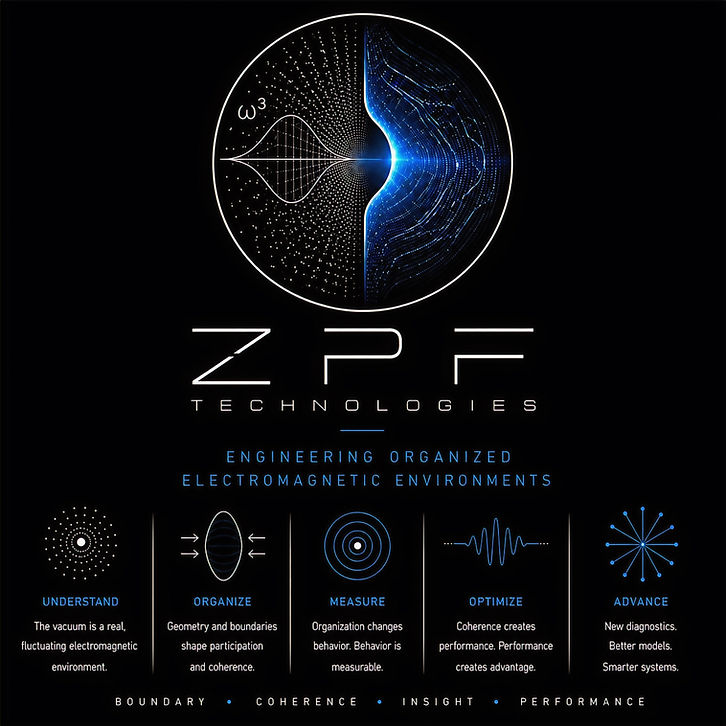
Engineering Organized Electromagnetic Environments

By 2028 ai enhanced nano fabrication will have advanced enough to create dynamic Casimir boundary MEMs designs far beyond current capabilities, just in time to test emerging frameworks in vacuum ontology. Applications of this technology will branch out in ways that are only limited by imagination. First experiments will concentrate on Quantum Vacuum Propulsion (QVP) for terrestrial and space vehicles. Practical use of the array will extend across the fields of physics, cosmology, telecommunications, medicine and more.
What if the Vacuum is not empty space, but an active part of the physical universe? At ZPF Technologies, we are investigating a possibility with profound implications for physics and engineering: that the electromagnetic vacuum is not merely the absence of matter, but a physically consequential environment whose fluctuations, correlations, and interactions with matter may hold important clues to the behavior of the universe. Our research centers on zero-point energy (ZPE), stochastic electrodynamics (SED), and the extended vacuum ontology developed by physicist and researcher Barry Setterfield. We seek to translate this theoretical framework into mathematical models, numerical simulations, measurable predictions, and ultimately experimental technologies. Our objective is not to invent a new fundamental force. It is to understand, map, and potentially engineer physical interactions that may already exist but remain incompletely understood. The Zero-Point Field: The Vacuum Is Not Nothing In quantum field theory, the vacuum is the lowest-energy state of the fields that permeate space. Even in that state, electromagnetic field fluctuations remain. For an electromagnetic mode of angular frequency ω, the familiar quantum harmonic-oscillator ground-state energy is: E₀ = ½ℏω The corresponding ideal free-space electromagnetic zero-point spectral energy density is: ρ_ZPE(ω) = ℏω³ / (2π²c³) Here, ℏ is the reduced Planck constant, ω is angular frequency, and c is the speed of light. The frequency-cubed dependence is especially significant. It describes a spectrum whose energy weighting increases rapidly with frequency, extending across an immense range of electromagnetic scales. This is more than a mathematical curiosity. The Casimir effect demonstrates that electromagnetic boundary conditions can produce measurable mechanical forces. When two conducting surfaces are brought sufficiently close together, the electromagnetic mode structure between them differs from that of unrestricted space, resulting in a measurable interaction. For ideal parallel conducting plates, the Casimir pressure is: P_C = −π²ℏc / (240a⁴) where a is the separation between the plates. This provides one of our fundamental engineering motivations: if electromagnetic boundary conditions can produce measurable forces on matter, then deliberately controlling those boundaries offers a practical way to investigate how matter and the vacuum exchange energy and momentum. Whether that exchange can support useful propulsion is a separate question that must be answered experimentally and through complete momentum conservation. Why We Follow Setterfield’s Extended SED Framework Conventional quantum electrodynamics provides an extraordinarily successful mathematical description of electromagnetic interactions. Our research does not discard those achievements. We use them as essential benchmarks. Stochastic electrodynamics offers a different starting perspective: treating the zero-point electromagnetic background as a physically real stochastic field and examining how matter responds to it. Researchers including Timothy Boyer, Harold Puthoff, Bernhard Haisch, and Alfonso Rueda have explored aspects of this approach, including proposals relating electromagnetic vacuum interactions to inertia. These proposals are not established replacements for standard quantum theory. They are, however, scientifically interesting avenues for asking deeper questions about the physical origins of observed behavior. Barry Setterfield’s work extends this line of inquiry further. In Setterfield’s proposed ontology, the zero-point field is not simply a passive background assigned fixed properties. It has a physical origin, a proposed cosmological history, and an active relationship with matter and electromagnetic propagation. His framework explores whether the vacuum’s effective electric and magnetic properties, the behavior of transient polarization phenomena, the propagation of light, and even the action scale represented by Planck’s constant may be connected through a common underlying physical state. This changes the questions we ask. Rather than assuming that every dimensional physical constant is an unrelated primitive quantity, we investigate whether some familiar quantities could be related manifestations of a deeper vacuum-state law. In our reconciled Setterfield–Miller framework, a dimensionless state parameter K describes a proposed homogeneous cosmological relationship: ℏ_eff / ℏ₀ = K ε / ε₀ = K μ / μ₀ = K c / c₀ = K⁻¹ Under the complete proposed scaling relationships, important combinations remain invariant: ℏ_eff c = constant α = e² / (4πεℏ_eff c) = constant Here, ε and μ represent the effective vacuum permittivity and permeability, and α is the fine-structure constant. The invariant α relationship also requires the corresponding charge scaling proposed in the model. These equations represent a conditional theoretical framework—not a demonstrated variation of physical constants. In particular, they do not establish that Planck’s constant changes near a massive object or inside an engineered cavity. Their significance is that they provide a mathematically constrained starting point from which deeper mechanisms and experimental consequences can be investigated. Making Setterfield Engineerable A physical ontology becomes an engineering discipline only when it produces equations, measurable quantities, reproducible experiments, and predictions that can be proven wrong. That transformation is the central purpose of the ZPF Research and Development Program. We are working to move beyond qualitative descriptions of vacuum fluctuations toward a quantitative understanding of their spatial organization, frequency dependence, correlations, collective response, and interaction with electromagnetic boundaries. An important part of this work concerns what are often described as virtual particle pairs. Within our developing framework, we investigate whether transient vacuum-polarization phenomena can be better described as collective responses of an underlying field rather than as a literal population of independently countable particles appearing and disappearing. More recently, we have also explored a deeper speculative possibility: that the observable electromagnetic vacuum response may emerge from underlying oscillatory or standing-pattern dynamics. Such a substrate has not been experimentally established, and its mathematical relationship to standard electromagnetic fields remains an open research problem. Our approach is to work from known physical constraints toward the missing constitutive laws. These laws must explain how an underlying vacuum state could generate measurable polarization, magnetization, charge response, electromagnetic propagation, and momentum transport. Some of our work has already produced useful mathematical results and eliminated proposed mechanisms that fail conservation, symmetry, or consistency tests. We have also constructed explicit electromagnetic vacuum-correlation models from the familiar frequency-cubed spectrum. The central microscopic law connecting these pieces remains an unsolved problem. Finding—or decisively ruling out—a stronger physical model is part of our continuing work. The ZPF Array: From Theory to Experimental Hardware One of our principal engineering initiatives is the ZPF Array, a proposed microelectromechanical systems (MEMS) platform designed to create precisely controlled, time-dependent electromagnetic boundary conditions. The current research architecture employs a multistage nanocavity structure with independently controlled piezoelectric actuators and engineered conductive cavity surfaces. By changing cavity geometry, driving frequency, phase relationships, material response, and potentially retained electrical polarization, the Array is intended to explore how electromagnetic fields respond to deliberately organized boundaries. Unlike a conventional static Casimir experiment, the Array is designed to investigate dynamic, asymmetric, and phase-organized electromagnetic environments. Its research program includes studies of electromagnetic mode redistribution, resonant behavior, correlated boundary motion, chiral or directional excitation, vacuum-sensitive field observables, and possible momentum transfer. The first objective is not to produce a predetermined thrust measurement. It is to establish a calibrated experimental platform capable of distinguishing ordinary electromagnetic, mechanical, thermal, and material responses from any reproducible behavior that current models cannot explain. Our engineering work has advanced through device architecture, multilayer electrical design, fabrication planning, numerical modeling, and experimental protocols. Fabrication qualification and physical validation remain essential next steps. We are building the means to ask the vacuum a precise experimental question—and to recognize the answer, including when that answer is no. Our Ultimate Research Goals Quantum Vacuum Propulsion One of our long-term objectives is to determine whether controlled interactions between engineered matter and the quantum vacuum could provide a useful propulsion mechanism without the expulsion of conventional onboard propellant. Our starting observation is simple: electromagnetic fields can transfer momentum to matter, and matter can transfer momentum to electromagnetic fields. The central propulsion question is whether carefully engineered, dynamically driven structures can create a sustained directional momentum exchange with an external field. A successful propulsion mechanism must obey energy and momentum conservation. For conventional emitted electromagnetic radiation, the familiar thrust limit is: F ≤ P_rad / c A proposal that exceeds this conventional radiation-recoil relationship would require evidence for an additional, explicitly identified momentum-transport mechanism—not merely an internal pressure imbalance or an unexplained force measurement. Our research therefore examines both conventional asymmetric electromagnetic radiation and more speculative Setterfield–Miller collective-response models, always requiring a complete accounting of the reaction momentum. Vacuum-Catalyzed Aneutronic Fusion Another long-term objective is to investigate whether engineered electromagnetic vacuum environments could influence processes relevant to nuclear fusion. Our particular interest includes proton–boron-11 fusion: p + ¹¹B → 3 ⁴He + 8.68 MeV This reaction is attractive because its principal products are energetic helium nuclei rather than the large neutron output characteristic of many conventional fusion approaches. Practical proton–boron fusion nevertheless presents formidable challenges, including high ignition requirements, energy losses, and possible secondary radiation. The Coulomb barrier remains a fundamental obstacle. Our research question is whether controlled electromagnetic environments, polarization responses, screening effects, or other rigorously established physical interactions could measurably alter fusion-relevant reaction probabilities or improve the efficiency of a larger fusion system. We are not claiming that zero-point manipulation has already reduced nuclear Coulomb barriers or demonstrated vacuum-catalyzed fusion. That effect remains an unverified hypothesis requiring quantitative theory and direct nuclear measurements. If such an interaction exists and can be controlled, its potential implications for clean energy could be substantial. Our Research Philosophy ZPF Technologies operates at the intersection of established physics, alternative theoretical interpretations, computational research, and experimental engineering. We are willing to investigate foundational questions that are often treated as settled assumptions, including the physical origin and organization of the vacuum, the relationship between matter and zero-point fluctuations, and whether Setterfield’s proposed cosmological framework contains experimentally recoverable laws. But proposing an explanation is not the same as demonstrating it. We distinguish established electromagnetic phenomena from conditional mathematical results, speculative microscopic mechanisms, and experimental claims. Our goal is to develop models that are internally consistent, compatible with established observations, and capable of making new testable predictions. The path from a proposed vacuum ontology to a functioning technology is demanding. It requires mathematical derivation, carefully controlled fabrication, independent measurement, and a willingness to abandon mechanisms that do not survive scrutiny. Our long-term vision is to transform the study of the zero-point field from a largely theoretical pursuit into an experimentally grounded engineering discipline. From mapping the physical structure of the vacuum to investigating new approaches to propulsion and fusion, ZPF Technologies is pursuing a fundamental question: What becomes possible when we learn not merely to observe electromagnetic environments, but to organize and engineer them?
Beyond the ZPF Array

Upon successful proof of concept of our ZPF Array we will have demonstrated that the vacuum can be engineered. All constants and by nexus thermodynamics will be shown to be emergent properties of the Zero-Point Energy Field.
ZPF Technologies will expand to develop technology that uses SED-based vacuum modulation techniques designed to lower the Coulomb barrier through catalyzed quantum tunneling, potentially increasing fusion cross-sections by 10-15% and increasing efficiency by 20-30% while minimizing unwanted neutron producing side reactions and bremsstrahlung losses. This means an accelerated timeline to net gain going from Q~1 to Q>4 with a simple retrofit. This adds $1-2 billion to a $5 billion valuation.


